What is a reusable rocket and how close are we to full reuse?
Space Bandits · 9 October 2026
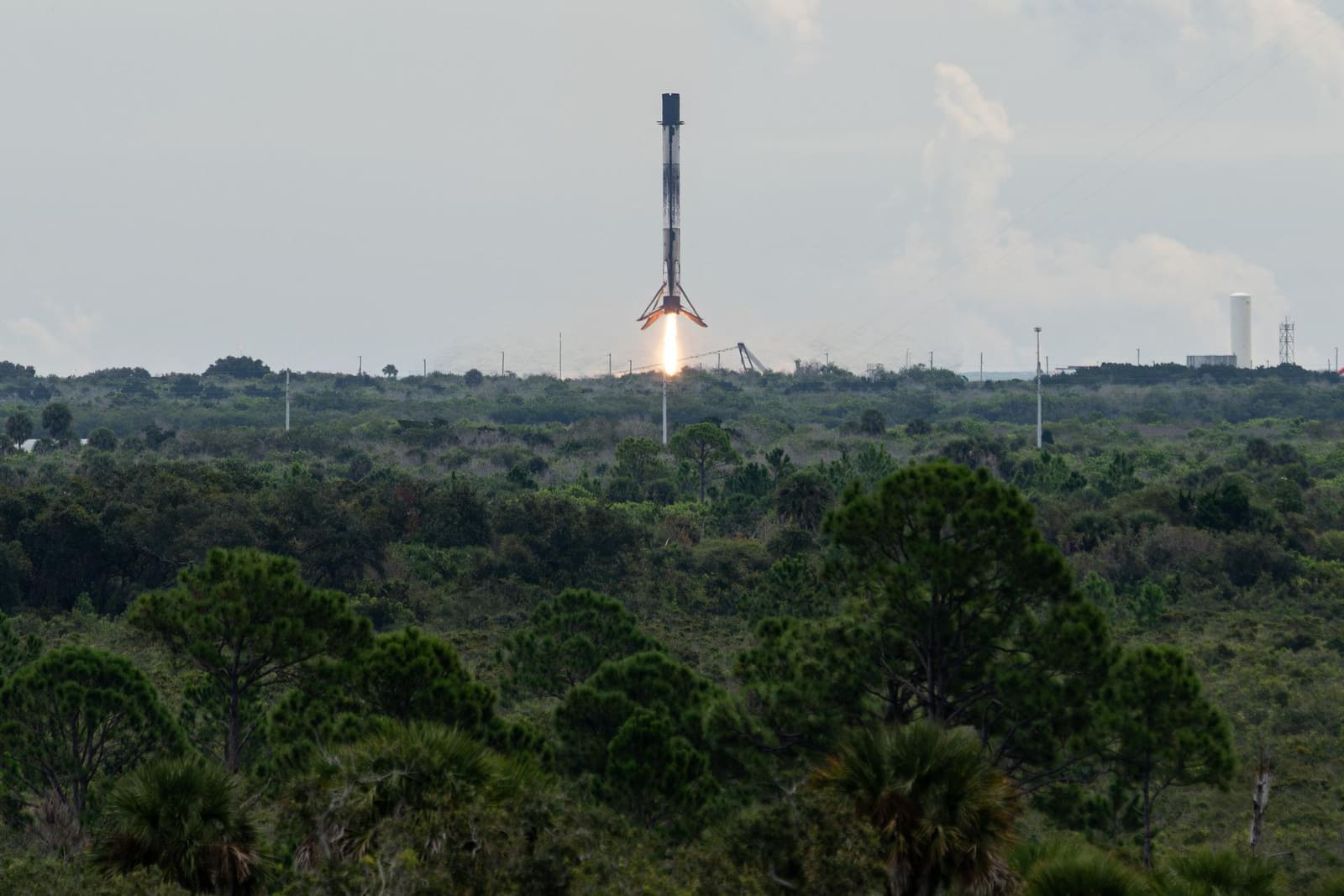
In short
- A reusable rocket lands its first stage so it can fly again. In 2018 Elon Musk said that stage makes up about 60 percent of the cost of a Falcon 9 launch.
- SpaceX reflies Falcon 9 boosters as a matter of routine. One booster has flown 37 times, and the fastest turnaround is nine days.
- Blue Origin has reflown one New Glenn booster. China recovered two orbital boosters in the summer of 2026 and has not flown either again.
- Nobody has reused a whole rocket yet. Starship reached orbit in September 2026, but its upper stage has not been caught and flown again.
For most of the space age, every rocket was thrown away after one flight. The most expensive part goes first. In 2018 Elon Musk said the first stage makes up about 60 percent of the cost of a Falcon 9 launch (Spaceflight Now). A reusable rocket brings that stage back so it can fly again.
In October 2026 that is routine for one company, new for a second, and a first step for China. Nobody has yet reused the whole rocket.
Why reuse matters
The Space Shuttle was the first try. Its orbiter and boosters flew again, but NASA's own analysis says the Shuttle "was extremely expensive, largely due to the high cost of refurbishing the Shuttle between flights." It put the cost at about $54,500 per kilogram to low orbit. The Falcon 9 advertised $2,720 per kilogram, about a twentieth as much (NASA). Reuse only pays if fixing a used rocket costs much less than building a new one. SpaceX's president, Gwynne Shotwell, said refurbishing a Falcon 9 booster cost "substantially less than half" of a new one (quoted in the same NASA paper).
The savings went to SpaceX more than to its customers. Reported estimates put SpaceX's internal cost for a reused Falcon 9 launch at about $15 million, while its list price rose from $70 million in 2025 to $74 million in 2026 (Spaceflight Now). Its rideshare price went up too, from $5,000 per extra kilogram in 2020 (TechCrunch) to $6,500 in 2023 (Payload).
How we got here
The idea of a rocket that lands upright is older than SpaceX. On 18 August 1993, the experimental DC-X made its first flight, a 60-second hover test in New Mexico. One of its stated goals was to "demonstrate rapid turnaround capabilities" (NASA). SpaceX and Blue Origin both fly rockets built on the same vertical launch and landing concept (Astronomy).
In November 2015, Blue Origin's New Shepard flew to 100.5 km and landed, the first rocket to launch a payload into space and come back down intact (collectSPACE). New Shepard is suborbital, though. In March 2017, SpaceX flew a Falcon 9 booster for a second orbital mission, the first reflight of an orbit-class booster (Scientific American).
Since then reuse has become normal for Falcon 9. On 25 August 2026, the booster B1067 flew its 37th mission, and that launch included SpaceX's 654th Falcon booster landing (Spaceflight Now). The fastest turnaround between two flights of one booster is nine days (BGR).
Not every method worked. In May 2022, Rocket Lab caught a falling Electron booster on a hook hanging from a helicopter. The pilot felt the load behave differently than in testing and let the stage go into the sea (Via Satellite).
Who else has landed an orbital booster
Blue Origin. New Glenn landed its first booster on the ship Jacklyn in November 2025, on the rocket's second flight (Gulf News). In April 2026 it flew the same booster again (TechCrunch). For that first reuse, Blue Origin replaced all seven of its engines (Spaceflight Now). Then, in May, a New Glenn exploded during a ground test. Blue Origin traced it to the main oxygen valve on one of its BE-4 engines and is aiming to fly again before the end of 2026 (Spaceflight Now).
China. On 10 July 2026, the state-owned Long March 10B became the first Chinese rocket to recover its first stage, caught in a net at sea. Its builder aims to fly that stage again by the end of 2026 (SpaceNews). Five weeks later, LandSpace landed a Zhuque-3 first stage on its legs in Gansu, the first Chinese commercial company to land an orbital-class booster. Video afterwards showed a fire breaking out at its base (Spaceflight Now). Zhuque-3 is designed to be reused up to 20 times (Scientific American). Another state rocket, the Long March 12A, reached orbit in December 2025, but its landing attempt failed (SpaceNews).
Starship. SpaceX's next rocket is meant to be reusable from top to bottom. In May 2025 it flew a Super Heavy booster a second time. Twenty-nine of its 33 engines had flown before (R&D World). On 28 September 2026, on its 14th flight, Starship reached orbit for the first time and released 26 Starlink satellites. The booster splashed down in the Gulf rather than being caught, and catching and reusing the upper stage is still ahead (Payload).
Why it is hard
Every kilogram of landing fuel is a kilogram of payload you don't carry. In 2016, SpaceX listed a reusable Falcon 9 at 5,500 kg to geostationary transfer orbit. The same rocket, thrown away, could lift 8,300 kg (SpaceNews). Bringing the upper stage back costs even more. Stoke Space's first Nova is designed to carry 3,000 kg to low orbit fully reusable, or 7,000 kg if it is thrown away (Payload).
Engines need work between flights. Blue Origin swapped every engine before its first reflight. SpaceX reflew most of a Super Heavy's engines on its first try. How many flights an engine survives decides how much a reused rocket really saves.
Upper stages come back at orbital speed. They need heat shields that survive reentry again and again with little work in between. After Starship's 13th flight, Dan Rasky, a co-inventor of the PICA heat shield material, told Gizmodo that Starship's current thermal protection is "a dead-end" for missions that need full and rapid reuse (Gizmodo).
The landing itself can go wrong. Rocket Lab's helicopter had to drop its booster. LandSpace's first Zhuque-3 booster was lost during its landing attempt in December 2025 (SpaceNews), and the second one caught fire after it landed.
Who's working on it
These are the launch companies in our directory with a stake in reuse, grouped by how far each has got.
Reflying boosters
SpaceX reflies Falcon 9 boosters as a matter of routine and is working toward a Starship that is reusable from top to bottom. Blue Origin has flown one New Glenn booster twice and plans to return to flight after its May explosion.
Landed, not yet reflown
LandSpace landed Zhuque-3's first stage in August 2026. A booster that has flown twice would be the next step.
Building rockets designed to land
Rocket Lab is building Neutron, a larger rocket with a reusable first stage. A first-stage tank ruptured in testing in January 2026, and its debut may slip into 2027 (Spaceflight Now). Stoke Space is building Nova, designed so both stages fly again (Stoke Space). Its first flight is now planned for early 2027 (Payload). Relativity Space is integrating engines on the first stage of Terran R.
In China, i-Space launched the country's first rocket recovery ship in August 2025 (Global Times). Space Epoch landed a 57-tonne stainless steel test vehicle in the sea under power in May 2025 (CGTN), and is aiming for an orbital launch and recovery attempt late this year (Caixin). Galactic Energy's Pallas-1 reached orbit on its first flight in September 2026, and later flights will try to recover the first stage (SpaceNews). Orienspace has raised money for the reusable Gravity-2 (SpaceNews). Deep Blue Aerospace has flown landing tests since 2022, and one failed in its final seconds in September 2024 (SpaceNews).
In India, Agnikul Cosmos has government backing to develop a reusable version of its Agnibaan rocket (Channel IAM). In Europe, the ESA-backed Themis demonstrator, which is not in our directory, has yet to make its first hop test (European Spaceflight).
The latest from each company

SpaceXGraduatedUnited States
Reusable rockets and spacecraft
- Achievement 28 September 2026 Starship reaches orbit for the first time on Flight 14 and deploys 26 Starlink satellites, though it loses an engine on the way up and is brought down after almost two orbits instead of 10 hours source
- Company 26 August 2026 Announces Starbase Louisiana, a $100B Gulf Coast Starship site with five launch complexes, building from 2027 for first launches in 2029 source

Blue OriginGraduatedUnited States
Orbital rockets and spacecraft
- Contract 1 September 2026 NASA awards a firm-fixed-price contract worth up to $700M to build, launch and operate the Mars Telecommunications Network orbiter, due by the end of 2028 source
- Anomaly 28 May 2026 A New Glenn explodes on the pad during a static fire test before its fourth flight; Blue Origin later traces it to the main oxygen valve on a BE-4 engine source

LandSpaceChina
Methane rockets that land
- Achievement 15 September 2026 A Zhuque-2E rocket puts 10 Qianfan satellites into polar orbit source
- Achievement August 2026 Zhuque-3 lands its first stage in Gansu, making LandSpace the first Chinese commercial company to land an orbital-class booster; video then showed a fire breaking out in its aft section source

Rocket LabGraduatedUnited States
Smallsat launch services

Stoke SpaceUnited States
The fully reusable Nova rocket

Relativity SpaceUnited States
3D printed rockets

Space EpochChina
Stainless steel rockets caught by the sea
Galactic EnergyChina
China's most-flown private rocket

OrienspaceChina
Big solid rockets launched from ships

Deep Blue AerospaceChina
Landing rockets before reaching orbit

Agnikul CosmosIndia
Rockets on single-piece 3D-printed engines
The latest milestones from each company's record. The newest is from 30 September 2026.
How close are we?
Reusing a first stage is solved for one company. SpaceX has flown a single booster 37 times. Blue Origin has done it once. China recovered two boosters this summer and has not yet flown either again.
Reusing the whole rocket has not been done. Starship reached orbit in September 2026, but its upper stage has not yet been caught and flown again.
Reuse is still slower than it sounds. The best turnaround for a Falcon 9 booster is nine days. An airliner flies several times a day.
What to watch
- China's first reflight of a recovered booster: the Long March 10B's builder is aiming for the end of 2026
- Space Epoch's first orbital launch and recovery attempt, late 2026
- New Glenn's return to flight, aimed at the end of 2026
- Stoke Space's first Nova flight, early 2027
- Rocket Lab's first Neutron flight, which may slip into 2027
- The first catch and reflight of a Starship upper stage